

Hand-Built
American Hardwood
Heirloom Furniture
Mennonite Furniture Studios American Hardwood Heirloom Furniture
What To Look For When Buying Quality Hardwood Dining Room & Kitchen Cabinetry For Your Home

The Discriminating Furniture Buyers Guide To Heirloom Quality Dining & Kitchen Cabinets
Do You appreciate beautiful hardwood furniture built by craftsmen to last for generations?
Are You seeking fine custome hardwood cabinets to grace Your dining room or kitchen?
If so, read this Furniture Buyers Guide To Heirloom Quality Dining Cabinets
Mennonite Furniture Studios Hardwood Dining & Kitchen Cabinet Guide – Download FREE e-Book
Hardwood Dining & Kitchen Cabinet Guide – Part 1
Hardwood Dining & Kitchen Cabinet Guide – Part 2
Hardwood Dining & Kitchen Cabinet Guide – Part 3
Hardwood Dining & Kitchen Cabinet Guide – Part 4

The Discriminating Furniture Buyers’ Guide To Heirloom-Quality Hardwood Dining & Kitchen Cabinets – Part 2
American Hardwood Dining Room Furniture

Hand-Built American Oak Heritage Dining Set With Dining Table, Bow-Back Windsor Chairs, & Curio Display Cabinet, by American Heirloom Furniture
Our Dining Room & Kitchen Cabinet Heritage
Furnishing styles and tastes continuously evolve, but throughout the decades no dining room could ever be considered complete without some form of cabinetry. Colonial, Shaker, Mission… there are many different styles of dining room furniture available to us from our rich heritage of North American furniture craftsmen.
Traditionally, the dining room cabinet was used to display the best china and crystal that a family possessed. These days, people also proudly display artistic figurines and collection pieces, as well as their children’s school art projects. Whatever they hold, these furniture pieces should always provide stable storage utility and a stylish focal point in the room. Share some time with us to consider the features that contribute to an ‘Heirloom Quality’ dining room cabinet, and why it provides such supreme and lasting value.
Unlike ‘built-in’ cabinets, that derive structural stability from the kitchen or dining room walls that support them, ‘free-standing’ dining room cabinets have to be sturdily constructed to support both their own weight and the often considerable weight of everything that we place within them, including silverware, crockery, glassware, collectibles, etc. Let us first recognize the various types of dining room cabinet favored in todays’ North American homes.
Floor-Standing Lower Cabinets

Heritage Colonial Sideboard
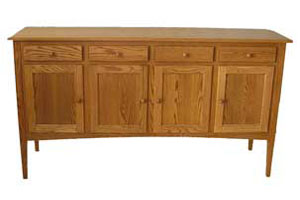
Heritage Shaker Buffet

Heritage Queen Anne Huntboard
Lower Cabinets And Upper Cabinets
There are several different types of popular dining room cabinet that are able to fulfill most people’s dining room storage and display needs. Floor-standing ‘Lower Cabinets’, like Sideboards, Buffets and Huntboards may be used alone, although sideboards are also often used in combination with ‘Upper Cabinets’, like Hutches, Dutch Cupboards or China Cabinets. Each of these cabinet types is available in a range of sizes, furniture styles, and finish colors to fit your tastes.
Floor-Standing Lower Cabinets
Lower Cabinets range from monolithic and capacious pieces to light and airy pieces and include (ordered by storage capacity):
Sideboard Cabinets
The Sideboard Cabinet is the work horse of the dining room. For the space it occupies, it provides more practical storage space than any other cabinetry piece. Serving utensils and ‘good’ flatware store handily in the shallow drawers, which, by the way, can be provided with optional silverware liners. Larger serving dishes and other utilitarian miscellany find their place behind the ample lower doors, where, though hidden from view, they are readily available.
Buffet Cabinets
The Buffet Cabinet provides a superb focal point for those whose entertaining style leans toward the casual. As a buffet table or a place to repose multiple courses, the longer buffet cabinets provide ample space for quite a spread. As with the sideboard, serving utensils and “good” flatware store handily in the shallow drawers (with optional silverware liners). Larger serving dishes and other utilitarian miscellany find their place behind the ample lower doors, where, though hidden from view, they are readily available.
Huntboard Cabinets
The Huntboard initially became popular in the first half of the nineteenth century in the mid-south, serving as a buffet table at the famous hunt breakfasts of the genteel cavaliers. We well suppose that after an early morning chase on horseback, they were more comfortable to serve themselves while standing. In our modern day, the huntboard fills a place in which storage space is not at a premium, but where a graceful accent piece, doubling as a serving table, is needed.
Combination Upper & Lower Cabinets

Heritage Colonial Sideboard With China Cabinet Top

Heritage Sideboard Cabinets With Dutch Cupboards On Top, Colonial Style (left) & Shaker Style (right)

Heritage Colonial Huntboard With Hutch Top
Upper Cabinets
Most people who buy a floor-standing sideboard cabinet either order a matching upper cabinet with it, or return later to take advantage of the increased storage capacity and aesthetic appeal that a well-crafted upper cabinet can offer. Popular combinations include:
Mennonite Furniture Studios Offers Matched Combination Top And Bottom Cabinets With A Range Of Furniture Styles (Colonial, Mission, Shaker), Cabinet Sizes, Cabinet Combinations, And A Wide Range Of Standard & Custom Furniture Finishes, To Ensure A Perfect Fit In Your Dining Room.
Sideboard Cabinet With China Cabinet Top
It is difficult to distinguish between Colonial cabinets intended for the library and those intended for the dining room, and the China Cabinet Top seems to have evolved from an Early American secretary bookcase. At some point, a creative housekeeper got the inspiration that she could display her family’s good chinaware behind glass bookcase doors just as well as their valuable book collection. It is also worth noting that the earliest cabinets for displaying dishes were often built-in corner cabinets.
Sideboard Cabinet With Dutch Cupboard Top
The Dutch Cupboard is a closed cupboard which has a small open space between the upper doors and the top of the supporting cabinet. These were popular among the ‘Dutch’ or German occupants of Colonial Pennsylvania and Maryland. Many of the very early prototypes had an extremely narrow open area which raises the question as to its original purpose. Todays’ Dutch Cupboards provide ample space to enable the top of the supporting cabinet to serve as a buffet table.
Huntboard Cabinet With Hutch Top
The Open Hutch Top is a kitchen piece whose origin seems to have been in simple open shelves hung on a kitchen wall. Its original purpose was, not so much to display the crockery and food items that it held, but rather to present them readily at hand when needed. As open hutches became more widely used and refined, they were generally placed on a closed sideboard or buffet cabinet, which provided additional hidden storage.
Mennonite Furniture Studios American Heirloom Furniture – Only The Best Endures!
The Quality Cabinets of yesteryear were built to last by caring men who thoroughly understood their tools, materials and craft.
Today our Mennonite & Amish furniture makers undergo an apprenticeship to develop keen eyes and skilled hands, and these expert craftsmen are dedicated to unhurriedly building Your legacy-quality dining room & kitchen furniture the right way – offering exceptional value without compromise!
NEXT>> Part 3 – What To Insist On When Buying Your Quality Hardwood Dining Room & Kitchen Cabinets